 ivan ottinger
 After cutting my phone bill, I turned my attention to optimising electricity consumption at home.
First, I made a list of almost all our appliances and split them into two tables:
- appliances that run most of the time (fridge, Wi-Fi router)
- appliances we only turn on when actively using them (washing machine, computer, vacuum, …)
I then noted down each appliance’s consumption in watts (W).
| Appliance | Consumption [W] |
|---|---|
| fridge | 30.8 |
| Wi-Fi router | 9 |
| Wi-Fi router 2 | 6 |
| external display (standby) | 1.3 |
Appliances that run most of the time
| Appliance | Consumption [W] |
|---|---|
| computer | 50 |
| desk lamp with LED bulb | 3 |
| air purifier (medium speed) | 11.1 |
| electric kettle | 2,000 |
Appliances we turn on when actively using them
Of course, the tables above only show some appliances — for illustration.
Where to find the wattage?
Good question. Some appliances list their consumption in the manual or on a label on the device itself. If neither helps, try searching online.
And if the internet doesn’t help either, there’s a device costing under €10 that can measure consumption for you. I bought a Solight DT26 — at the time of writing it was selling for €8.29. There are similar devices from other brands at a similar price.
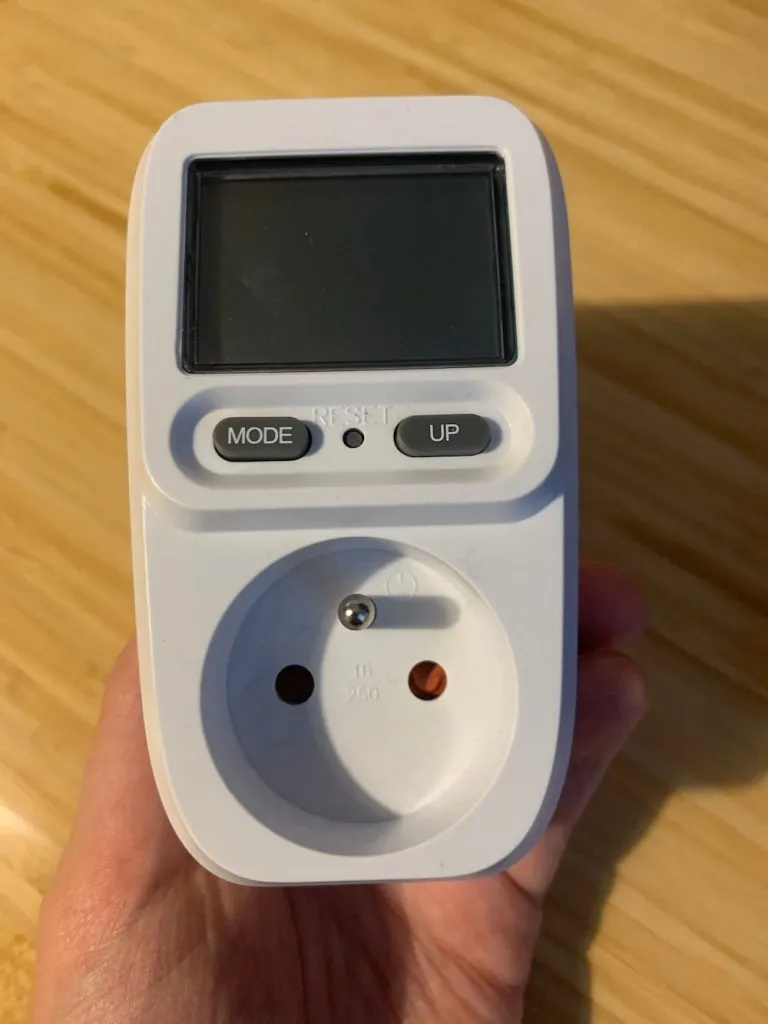 Solight DT26 energy meter
It works simply — plug it into the wall, then plug your appliance into it. The display shows real-time consumption in watts.
Some appliances don’t list power in watts but, like our fridge, in kWh per 24 hours.
Example: 0.74 kWh/24h
Data in this format can actually simplify the whole calculation significantly.
Electricity price
Once we’ve noted down the consumption of all devices, we need to find out how much one Wh — or one kWh — costs us.
You can get the price from individual invoices or your electricity provider’s tariff, but I think it’s simpler to work from the annual statement (if you have one). It contains both the total price and total consumption. We simply divide the two:
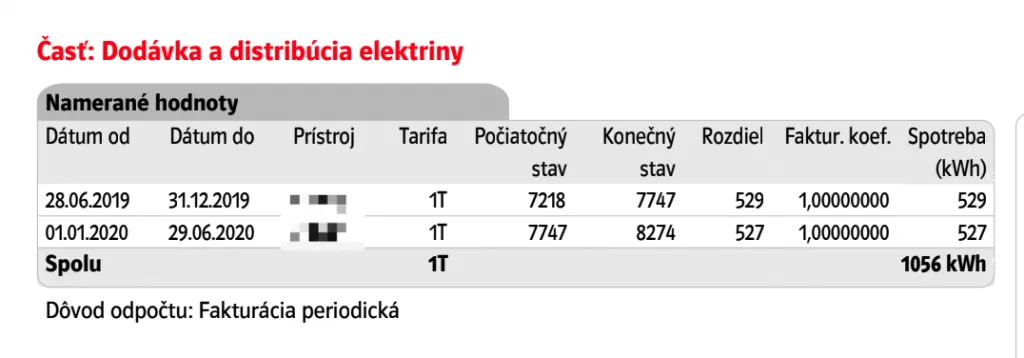 Total consumption in kWh for the billing period
 Total price for the billing period
From the statement we can calculate the price per kWh:
Price per kWh = Total cost / total consumption Price per kWh = €219.19 / 1,056 kWh = €0.21 / kWh
Now that we have the energy price, we can calculate how much each appliance costs us.
Let’s start with the appliances that run almost all the time.
Fridge
Probably one of the biggest energy consumers that we never switch off. If the fridge runs 24 hours a day, 365 days a year, it will cost us:
Cost per year = Consumption [W] × 24 hours × 365 days × Price per kWh / 1,000
Cost per year = 30.8 W × 24 × 365 × €0.21/kWh / 1,000 = €56.06.
So the fridge costs us €56.06 a year, or €4.67 a month.
ℹ️ If your fridge lists consumption as X kWh/24h (e.g. 0.74 kWh/24h), the calculation is simpler. Just multiply the consumption by 365 days and the price per kWh — you’ll arrive at the same result as calculating via watts.
We can calculate the other always-on appliances in the same way:
| Appliance | Consumption [W] | Cost per year [€] | Cost per month [€] |
|---|---|---|---|
| fridge | 30.8 | 56.06 | 4.67 |
| Wi-Fi router | 9 | 16.36 | 1.36 |
| Wi-Fi router 2 | 6 | 10.91 | 0.91 |
| external display (standby) | 1.3 | 2.36 | 0.20 |
Appliances that run most of the time
The same formula works for appliances we only switch on when needed, except instead of “24 hours × 365 days” we count only the actual time the appliance was running:
Cost = Consumption [W] × X hours × Y days × Price per kWh / 1,000
Example: We’re working from home on a computer 8 hours a day, 200 days a year. Average consumption is 50 W.
Cost = 50 W × 8 hours × 200 days × €0.21/kWh / 1,000 = €16.80.
So during a year of working from home we’d pay a total of €16.80 in energy for the computer.
One wash, one bake, boiling 0.5l of water
Not every appliance runs continuously. I was curious how much it costs to:
- run one 60-minute wash at 40 °C
- bake a cake
- boil 0.5 litres of water in a kettle
I used the same device mentioned above (Solight DT26).
I reset it, entered the price of €0.21/kWh, plugged in the kettle first, set it to boil, and watched what appeared on the display.
I repeated the process for baking and washing.
Here are the results:
| Activity | Cost [€] |
|---|---|
| Boiling 500 ml of water | 0.21 |
| Baking a cake in an electric oven | 0.80 |
| One 60-minute wash at 40 °C | 0.11 |
You can measure any activities that are relevant to you in the same way.
Findings
After measuring everything I could, I realised the following:
- it makes sense to have an energy-efficient fridge, because its consumption can significantly affect the total electricity bill; if your fridge is older, it’s definitely worth checking its consumption and considering whether to replace it; we can also think about whether the fridge is oversized for our needs
- a Wi-Fi router running 24/7 can also be a non-negligible energy drain. At our home, running the routers costs about €27/year.
- it’s worth checking other devices that spend long periods in standby mode
- consumption of some appliances varies depending on how we use them; for example, a computer playing video at full brightness will consume differently than the same computer while writing a document or listening to music
Action
As I mentioned above, the biggest area for savings in our household was optimising Wi-Fi router consumption.
I realised they were running needlessly for about 8 hours each night (every day).
My solution was a simple plug-in timer — Elektrobock ZSD16 — for about €10. The timer can be set so that connected devices are on from, say, 6:00 to 22:00 every day. The rest of the time the timer keeps them off.
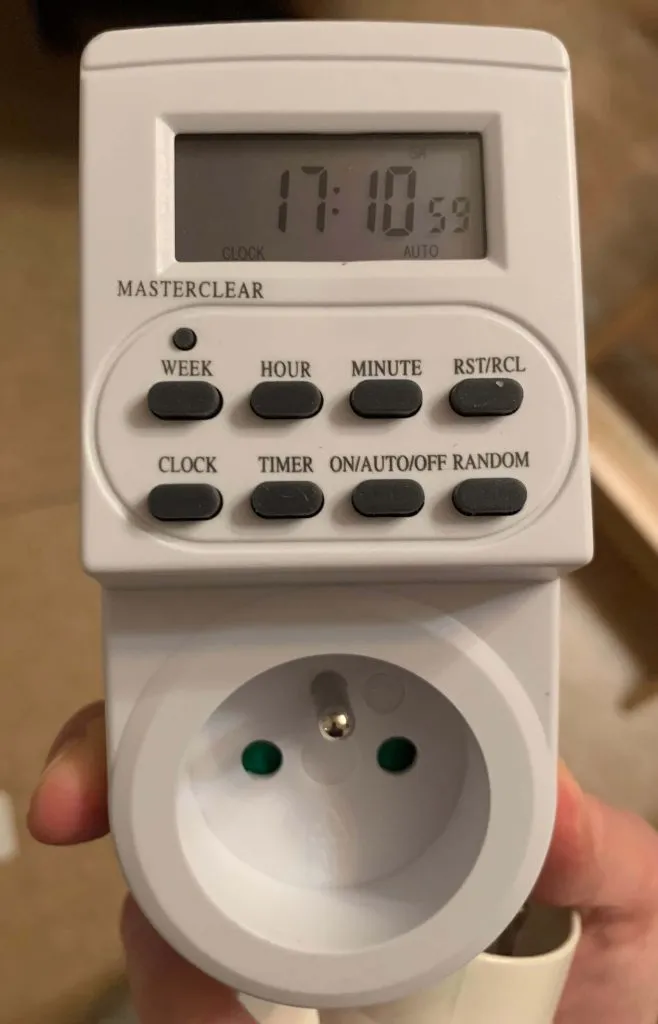 Elektrobock ZSD16 timer
Over a full year the timer saves us a third of €27, which is €9/year. After about a year the timer pays for itself through saved consumption, and every subsequent year we save €9.
I know, it’s not a lot — but it’s saved energy and money, and the good feeling that we’re wasting less.
I’m sure you’ll find some area where you can save too. Maybe it won’t be the Wi-Fi router — maybe it’ll be the fridge. Or some other unexpected energy hog…
By the way, if you end up buying an energy meter, you can pass it on to another household afterwards — so it doesn’t just sit in a drawer unused. :)
Translated from the Slovak original.